
About OPR
At the top of every team page on FTCScout is a "Quick Stats" panel showing a team's "Best OPR" across several categories. But what exactly is OPR?
History of OPR
The term "Offensive Power Rating" (OPR) was first coined by Scott Weingart in 2006, according to Team 2834.
He described using linear algebra to calculate the average contribution of a robot to their alliance during play. While I could walk you through each step of that process, The Blue Alliance already did an excellent job on their own post explaining the math behind OPR calculations, so I won't reinvent the wheel, and will instead refer you to them.
What exactly is it?
OPR boils down to one metric - How many points does a team contribute to their alliance, on average, at an event? It is important to make the distinction that OPR is not simply your average match score, divided by 2. OPR takes into account how good your alliance partners are, to figure out on average how many points you contributed to the team.
This means that in theory, you could take the OPRs of 2 teams, add them together, and get a pretty good estimation for what the resulting score would be, were they ever to alliance.
Limitations
With great power comes great responsibility
It is incredibly easy to misunderstand or misinterpret OPR. If you use it as your only metric for scouting, you're not scouting. OPR is an important tool in a good scouter's toolkit, but when all you have is a hammer, everything looks like a nail. Here are some reasons not to rely on it:
It's called Offensive Power Rating for a reason
In seasons with substantial defensive play, OPR will end up overlooking defense as a metric. OPR tracks how well you do, but not how well you stop the other team from succeeding. Just because a potential alliance partner does not score many points does not mean that they won't help you win the match.
It's only as good as the data it has
Early on in an event, before enough matches have been played, OPR is completely useless. Before the algorithm has enough data, it will not give relevant results. Give the algorithm at least 4 matches to figure out what's going on.
Robot compatibility
Just because two robots have high OPRs does not mean they will work well together. If both robots have their autos perform best on the same side, only one of them will be able to perform at their best. Before picking an alliance partner, make sure to watch their matches and see how they play. Better yet, go to their booth and ask them about it.
Consistency
OPR is exactly what it says on the tin - a rating. It assumes consistent performance, and doesn't account for improvements or declines in performance over time. If a team fixes a bug in their code, or a mechanical issue, their OPR will not account for that. You still need to scout the good old-fashioned way if you want to do it right.
Common Questions
How does negative OPR happen?
This is what happens when a team has a really good alliance partner, but together, they end up scoring really poorly. This can sometimes be the fault of the alliance partner's robot breaking down during a match.
What is Auto/Teleop/Endgame OPR?
Auto/Teleop/Endgame OPR is the same as normal OPR, but only for that specific period. This gives a more detailed picture of a team's strengths and weaknesses.
Do penalties affect OPR?
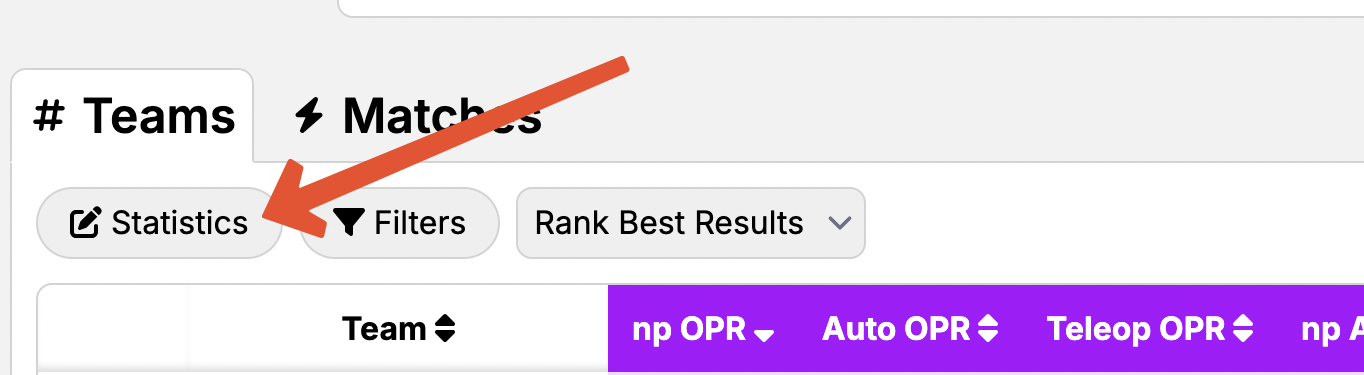
Most often on FTCScout, penalties are not calculated in OPR, which is why you sometimes see it written as "npOPR" or "Total NP OPR". We do still make available a penalty-inclusive OPR, which you can view on the Season Records page by editing the displayed Statistics.